CommuteWise
Scope
Case Study · Concept Exploration
Client
Personal
Year
[2026]
Industry
Travel
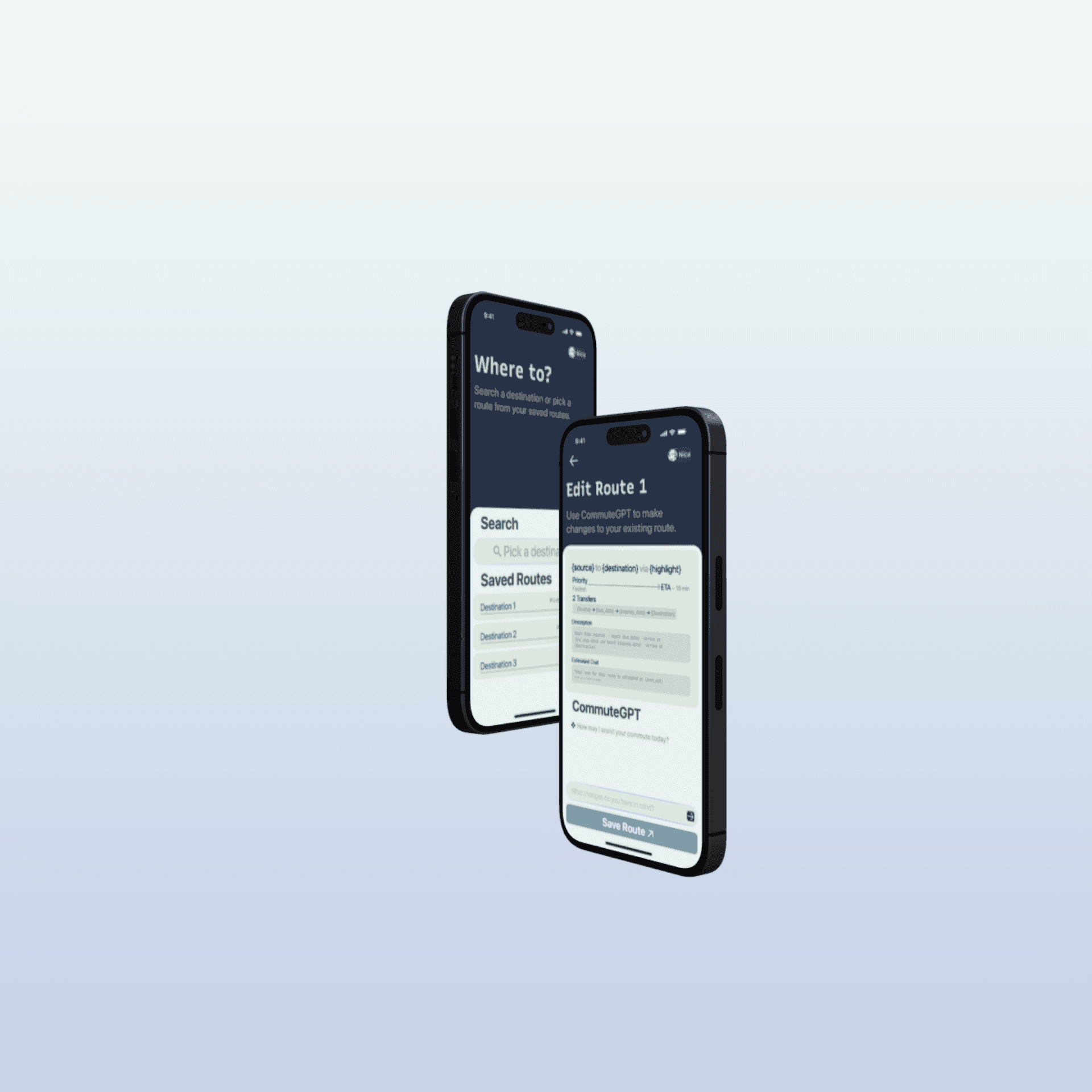
CommuteWise is a concept mobile application designed to reduce anxiety and uncertainty when navigating public transportation. Many commuters struggle with complex transfers, unfamiliar routes, and poor signal connectivity while traveling. This project explores how clearer route breakdowns, landmark-based navigation, and flexible mid-journey editing can improve confidence during daily commutes.
Through user research and prototype testing, the project investigates how commuters evaluate routes, interpret transit information, and respond to unexpected changes while traveling. The result is a design concept that emphasizes clarity, adaptability, and contextual guidance throughout the commuting experience.
Context
Public transportation systems can be difficult to navigate, particularly for first time commuters or those traveling through unfamiliar areas. Interviews and observational research revealed that many users rely on landmarks instead of street names, experience anxiety when transfers are unclear, and struggle when routes must be adjusted mid journey. Existing navigation tools often assume stable connectivity and rigid routes, leaving users without sufficient support when plans change.
Approach
The project followed a structured UX process including exploratory research, persona development, journey mapping, and iterative prototyping. Low fidelity wireframes were used to test core concepts such as route summaries, landmark based guidance, and the idea of a conversational route editing tool called CommuteGPT. Moderated usability sessions with five participants helped validate whether commuters valued these concepts and identified opportunities to simplify route understanding and mid journey adjustments.
Outcome
The final concept demonstrates how clearer route visualization and flexible editing can improve commuter confidence. Key design outcomes include structured route summaries, map context for orientation, and a conceptual GPT powered interface that allows users to modify routes without restarting navigation. While the project is exploratory, it highlights how AI assisted tools and stronger contextual cues can make public transit systems easier to navigate.
Credits
UX Research, Product Strategy, Interaction Design, and Visual Design were conducted as part of an independent UX case study project.
Saraj Raja