QueueEase
Scope
Case Study · Concept Exploration
Client
Personal
Year
[2026]
Industry
Civil/Government
QueueEase is a conceptual mobile application designed to help citizens navigate government office visits more efficiently. Many public service environments such as RTO offices involve long, unpredictable queues and unclear process steps. This project explores how mobile queue visibility, QR based queue entry, and step by step guidance could reduce uncertainty and help users understand what to do during their visit.
The project focuses on simplifying the experience of joining a queue, monitoring progress, and knowing when and where to proceed next.
Context
Citizens visiting government offices often face unclear procedures, long waiting times, and confusion about which counter to approach. First time visitors especially struggle with understanding service flows and queue systems. QueueEase was designed as a concept to explore how a mobile interface could improve transparency during these visits.
The project focuses specifically on RTO service scenarios as an initial context to test the idea of queue visibility and guided navigation inside government offices.
Approach
The design process began with defining user personas and mapping a typical government service journey. Based on these insights, I created low fidelity wireframes to explore the core interaction flow including service selection, joining a queue via QR scan, monitoring queue progress, and receiving a turn notification.
A mid fidelity interactive prototype was then tested through moderated usability walkthroughs with five participants. Observations from these sessions informed design refinements that improved clarity around queue status, guidance, and next steps.
Outcome
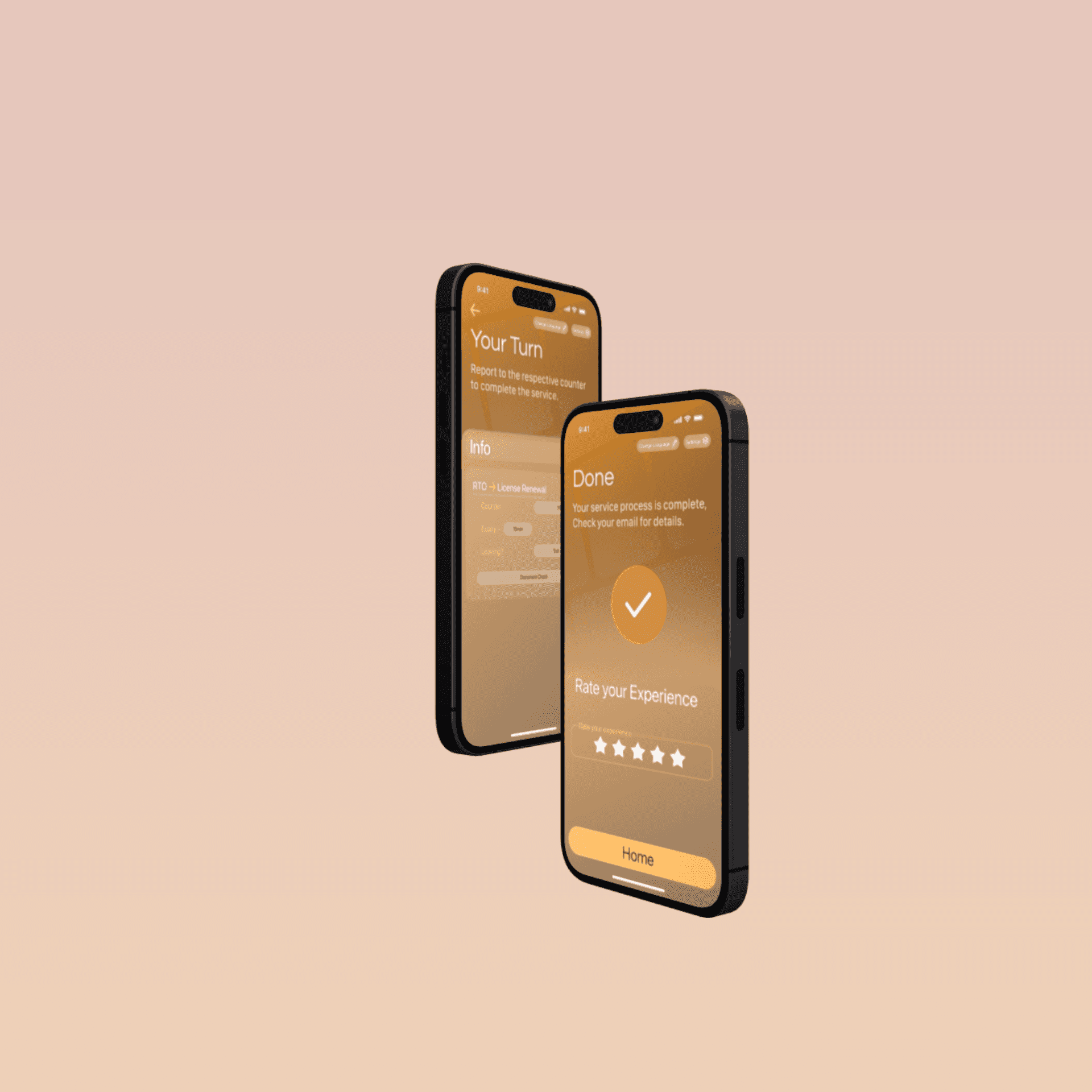
The final prototype demonstrates a simplified queue journey where users can join a service queue using a kiosk QR code, track their position in line, and receive a clear notification when it is their turn. The interface emphasizes transparency and step by step guidance to reduce confusion during office visits.
While the concept was not developed into a production system, the project highlights how clearer queue visibility and process guidance could improve the experience of navigating government services.
Credits
UX Research, Product Strategy, Interaction Design, and Visual Design were conducted as part of an independent UX case study project.
Saraj Raja